The Power of Remarkable

It could hardly have been better timed. After writing last week about achieving the remarkable, I received a newsletter from Charles Bennett, Partner and Thought … Read more
It could hardly have been better timed. After writing last week about achieving the remarkable, I received a newsletter from Charles Bennett, Partner and Thought … Read more

Where does your company rank in the echelons of “best employer” or “best company to work for”? After all the likelihood is that, even if … Read more

With 3 in 10 jobs in the US held by the self-employed and their sub-contractors there is no doubt that the workplace is changing. (Source) … Read more

True leadership isn’t about antiquated ideas of traditional leadership or leadership development, but about ensuring that you create a culture and environment in which everyone cares: in which everyone is a leader. That is why every individual matters.

Most “disruptive” ideas – like the examples rejected by IBM – were first mooted internally. Their originators, however, had the conviction, determination and drive to pursue them and see them through to success, with the ultimate financial rewards that followed. We call that entrepreneurial spirit, but there is no reason why it has to occur outside the organisation. Supporting their development and offering the originator a royalty in return, creates the best of both worlds. It taps into the creative capabilities of your most important assets whilst simultaneously ensuring that results remain “in-house.” That, surely, is the ultimate win-win.

Just imagine how you could transform your results if you could:-
Inspire you people towards a common goal;
Enable them to stretch themselves to fulfil their own potential in the process; and
Collaborate effectively to achieve that common purpose.
My model of employee ownership provides the framework to create this.

Employee engagement provides a convenient heading for describing what you need, and some solutions for what can help. But unless you provide a framework that addresses both employees’ immediate and future needs your efforts will be doomed, and you will experience the same lack of strategic success that Harvard and Fortune describe.
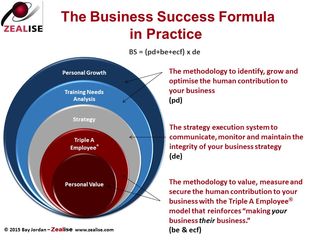
This very effectively illustrates the virtuous circle of the formula and the reinforcing aspect of its independent and inter-dependent elements. As people develop themselves they will increase their asset value, inevitably enabling them to make a greater contribution to the organisation and help execute strategy effectively. Note that, per the formula, disciplined execution is the multiplier and this will be boosted by their ownership stake which will make them more naturally inclined to do so.
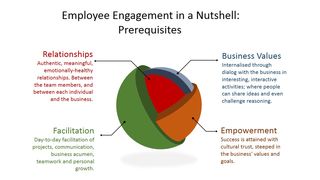
To create the kind of strategic alignment that ensures your strategy is executed you have to build effective relationships. That starts with a clear understanding of what the individual wants, and melding that with the organisational needs. This is core but is about so much more than just employee engagement.
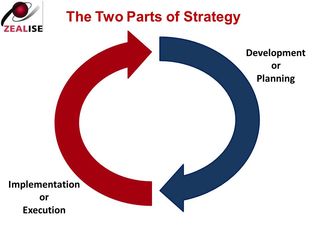
Only when you properly and fully align individual, team and organisational goals can you deliver a total strategy. Thus HR should play an essential role in executing strategy. If HR understands this, and can articulate it effectively, there should be no confusion about their role and the gap in understanding can be closed for once and for all.