Do You Really Want Contract Workers?

It started before the “Great Recession” but that period of economic history has seen it proliferate even more. Certainly reports suggest the trend of hiring … Read more
It started before the “Great Recession” but that period of economic history has seen it proliferate even more. Certainly reports suggest the trend of hiring … Read more

Have you noticed how employee engagement statistics rarely change? It does not seem to matter who conducts the research or whether it applies to the … Read more

Included in yesterday’s reports of falling UK unemployment was a statistic that a record number of people are self-employed. You cannot help wondering what this … Read more
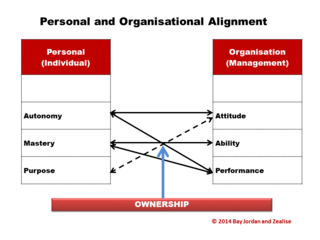
Employee ownership strengthens an employee’s sense of purpose and thereby changes their attitude, but it also helps break the tradition of looking at people purely as a cost and so reinforces the sense of autonomy that builds a virtuous cycle that perpetuates and solidifies the organisational alignment and hence the organisational integrity. Why would you not want to consider this – especially when you can do it at virtually no cost to either individual or organisation? It offers a better employee engagement remedy than anything else in the market.

The challenge Last week we looked at the statement “people are our greatest asset” and found that it was more than a cliché. The definition … Read more

The leader leads and the boss drives. Employee ownership links the life-investment your people are making in your organisation with a sense of shared purpose. It serves as a catalyst to create the autonomy, mastery and purpose that will deliver the well-being and emotional equity to secure employee engagement and sustain better performance and better results. It will thus enable you to stop driving and lead more effectively.

The divide between leadership and management is being perpetuated and exacerbated by our modern systems.
Increasingly sophisticated systems have accelerated business to the extent they have thrust decision-making ‘down-the-line’ and created what is popularly called distributed leadership or decision making. That is a good thing, but unfortunately, with their built-in and rigid controls to anticipate and cover every possibility, they have, paradoxically, also taken away the decision making capability from the people who operate them.

If nobody ever sets out to do a bad job, why do we need to spend so much time and effort controlling how people do/did their work?

All these massive benefits begin by simply recognising that employees are people and not resources.
It is natural whenever you come across a definition (on a subject that interests you) to try to put it into your own words. That … Read more